
Draft plan aims for 650 affordable homes a year by 2030 against a need of 1,730, with 2,202 households on the list. Have your say by 29 November.
West Northamptonshire Council has opened a six-week consultation on its housing strategy for 2027 to 2032. It closes at midnight on Sunday 29 November.
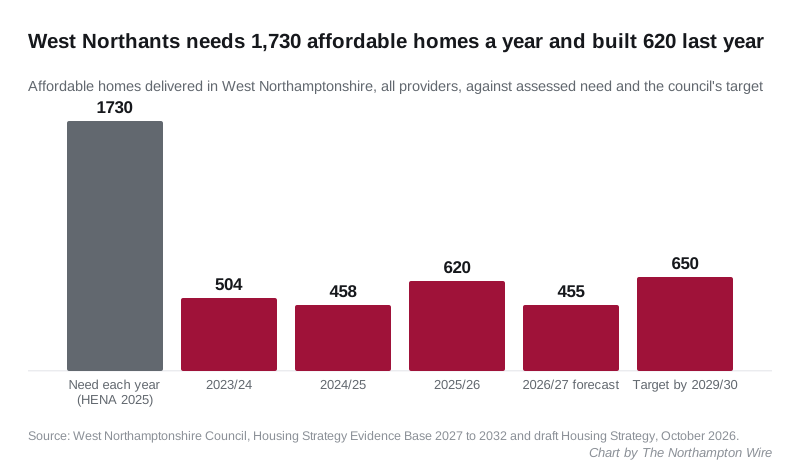
The draft sets the council’s housing priorities for the next five years. Its own evidence shows how far behind the district is. West Northamptonshire needs around 1,730 new affordable homes a year. Last year 620 were built, and the best the council aims for is 650 a year by 2030.
The council announced the consultation on 19 October. Cabinet approved it on 12 October, as we reported in Council this week.
What the strategy covers
The draft is built on four themes:
- Delivering the homes communities need: more affordable and specialist housing
- Becoming a high performing landlord for the council’s own 11,373 homes
- Supporting independent living: preventing homelessness and expanding supported housing
- Strengthening the private rented sector: standards, enforcement and empty homes
The full consultation draft runs to about 50 pages. The figures below come from the separate evidence document published alongside it, unless we say otherwise.
The gap between need and building
The council’s Housing and Economic Needs Assessment of 2025 found the district needs 2,503 homes a year, including about 1,730 affordable ones. The draft strategy is frank about this. It says delivery “at this scale is unlikely to be achieved” because of viability, funding, infrastructure and market capacity.
Affordable homes built in West Northamptonshire, by all providers:
| Year | Affordable homes | Of which built by the council |
|---|---|---|
| 2023/24 | 504 | 91 |
| 2024/25 | 458 | 31 |
| 2025/26 | 620 | 36 |
| 2026/27 (forecast) | 455 | not split out |
Of last year’s 620, 276 were for affordable rent, 226 for shared ownership and 112 for social rent, the cheapest tenancy. Six were rent to buy.
The forecast for this year, from housing associations’ own pipelines, is lower again at 455.
The council wants to build more itself. The draft targets about 150 new council homes a year by 2030, up from 36 last year. The evidence document says the drop from 91 homes was a “transitional phase” while its 2024 delivery plan got going.
The 650 target is worded two ways. The evidence document says the council will work with partners to deliver “a minimum of 650 affordable homes per year by 2029/30”. The performance table in the draft strategy says “up to 650”. That is a point worth raising in the consultation if it matters to you.
Who is waiting
On 31 March 2026, 2,202 households were on the council’s housing register.
- 1,024 needed a one-bedroom home, almost half the list
- 699 needed two bedrooms
- 350 needed three bedrooms
- 129 needed four or more
The most common reason for being on the list was being homeless or threatened with homelessness, which applied to 1,002 households. Households can be counted under more than one reason.
Homelessness has risen. In 2025/26, 5,151 people asked the council for housing and homelessness advice, up 4.5% on the year before. The end of a private tenancy was behind 35.5% of cases in 2024/25, up from 32.8%.
Temporary accommodation peaked at 760 households during 2024/25 and fell to 672 by the end of March 2026. The council says that is still well above 2023/24 levels. An estimated 53 people were sleeping rough on a single night in November 2025.
The council as landlord
The council owns 11,373 homes. On 31 March, 862 of them, 7.6%, did not meet the Decent Homes Standard.
The draft confirms that Northamptonshire Partnership Homes, the company that ran those homes, is being brought back under direct council control. That followed the council’s self-referral to the Regulator of Social Housing in 2024 and a C3 grading. The council’s business plan puts the cost of maintaining and improving its homes at about £577 million over 40 years.
Tenants’ satisfaction scores for 2025/26 were based on about 10% of tenants responding:
- 71.0% satisfied with the landlord service overall
- 78.1% satisfied that their home is safe
- 76.7% satisfied with repairs
- 36.6% satisfied with how complaints are handled
Renting privately
Average private rent in West Northamptonshire was £1,066 a month in January 2026, up 4.8% in a year, according to ONS figures in the evidence document. The median house price is almost eight times median earnings, above the England and East Midlands ratios. Our house prices page tracks the monthly figures.
The council licenses about 1,200 houses in multiple occupation. Complaints to its private sector housing team rose from 579 in 2023 to 1,345 in 2025. Since 2018/19 it has issued 229 civil penalty notices worth about £1.06 million.
About 800 homes in the district are long-term empty, and more than 100 of those have been empty for over five years. The draft says bringing them back into use is part of the plan.
What it means for you
If you rent from the council, rent privately, are on the waiting list or own a home here, this is the document that sets housing priorities until 2032. The council says it wants to hear from tenants, homeowners, landlords, developers and community groups.
You can respond by:
- the online survey, which the council says takes about 10 minutes
- an Easy Read version with its own survey
- email to ConsultationHousingStrategy@westnorthants.gov.uk
- post to Draft Housing Strategy Consultation, Housing Strategy and Enabling Team, West Northamptonshire Council, One Angel Square, The Service Yard, Northampton NN1 1ED
- phone on 0300 126 7000 for help or another format
Responses are anonymous, according to the consultation page. The final strategy goes to Cabinet in early 2027.
The housing numbers in the district’s new Local Plan are a separate consultation, which closes on 16 November. Our Local Plan guide explains how to respond to that one.
Sources
- West Northamptonshire Council, news release, 19 October 2026
- Consultation page, read 21 October 2026
- WNC Housing Strategy consultation draft, October 2026 (PDF)
- Housing Strategy Evidence 2027 to 2032 (PDF)
Have your say